


































NASA’s Artemis II Executes Key Lunar Burn, Sending Astronauts Toward Moon
NASA’s Artemis II advances lunar exploration as astronauts head toward the Moon, marking a historic return to deep space and future mission readiness

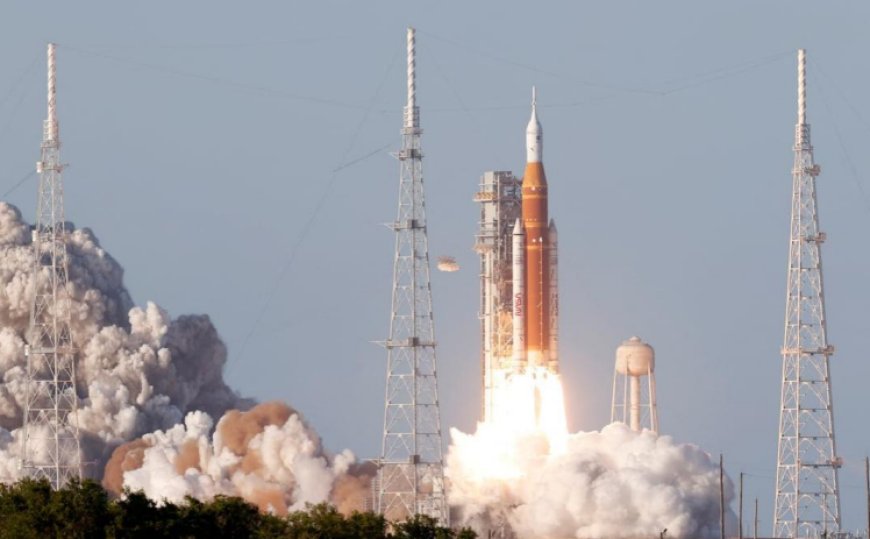
NASA has achieved a major milestone in its Artemis program as the Artemis II mission successfully executed a critical maneuver, placing astronauts on a trajectory toward the Moon. The Orion spacecraft, carrying four astronauts, performed a translunar injection burn, enabling it to exit Earth’s orbit and begin its journey into deep space.
This marks the first time in more than five decades that humans have traveled beyond low-Earth orbit, echoing the historic Apollo era while ushering in a new phase of space exploration. The maneuver is widely regarded as one of the most technically demanding stages of the mission, requiring precise timing and coordination between onboard systems and ground control.
The mission is part of NASA’s broader Artemis initiative, which aims to establish a sustained human presence on the Moon and lay the groundwork for future missions to Mars. With the successful execution of this maneuver, Artemis II has moved from launch phase into deep-space operations, marking a pivotal moment in modern space exploration.
Mission Overview and Crew Composition
Artemis II is a 10-day crewed mission designed to orbit the Moon and return safely to Earth, serving as a critical test flight for future lunar landings. The mission was launched aboard NASA’s powerful Space Launch System rocket from the Kennedy Space Center in Florida.
The crew includes Commander Reid Wiseman, Pilot Victor Glover, Mission Specialist Christina Koch, and Canadian astronaut Jeremy Hansen. This diverse team represents several historic firsts, including the first woman, the first Black astronaut, and the first non-American to participate in a lunar mission.
The Orion spacecraft, named Integrity, is making its first human flight and is equipped with advanced life support, navigation, and communication systems. Throughout the mission, astronauts are conducting system checks and gathering data to validate the spacecraft’s readiness for future deep-space missions.
The Critical Maneuver and Its Significance
The successful execution of the translunar injection burn represents the defining technical achievement of the mission so far. This maneuver involved igniting the spacecraft’s propulsion system to accelerate Orion to speeds exceeding 22,000 miles per hour, allowing it to break free from Earth’s gravitational pull.
In addition to this key maneuver, earlier orbital adjustments such as the perigee raise burn helped refine the spacecraft’s trajectory and position it correctly for its journey toward the Moon. These sequential operations demonstrate the precision and reliability of NASA’s navigation systems.
The success of these maneuvers confirms the effectiveness of both the Space Launch System and the Orion spacecraft. It also validates mission planning and execution protocols, which are essential for more complex operations, including lunar landings and long-duration missions beyond Earth orbit.
Journey Beyond Earth Orbit and Historic Milestones
Following the maneuver, Artemis II has entered a historic phase, with astronauts traveling more than 100,000 miles from Earth, a distance not achieved by human crews since 1972. This milestone underscores the mission’s significance in reestablishing human presence in deep space.
The spacecraft is set to follow a free-return trajectory, taking it around the far side of the Moon before returning to Earth. This path ensures that even in the event of system failure, the spacecraft can safely return using the Moon’s gravitational pull.
Astronauts are using this journey to conduct scientific observations, capture images of Earth and space, and test onboard systems under real deep-space conditions. These activities provide valuable data that will inform the design and execution of future missions.
Scientific Objectives and Technological Testing
A primary objective of Artemis II is to validate the performance of the Orion spacecraft and its systems in a deep-space environment. This includes testing life support systems, communication links, navigation capabilities, and thermal protection mechanisms.
The mission also serves as a platform for testing human performance in space, including physical health, psychological well-being, and operational efficiency. Astronauts are conducting routine exercises, system checks, and emergency preparedness drills to simulate real mission conditions.
Additionally, the mission is capturing high-resolution imagery and scientific data, including observations of the Moon’s far side and Earth’s atmosphere. These findings contribute to both scientific research and mission planning for future lunar exploration.
Outlook
The successful execution of the key maneuver in the Artemis II mission represents a major step forward in humanity’s return to the Moon. By demonstrating the capability to safely send astronauts beyond Earth orbit, NASA has laid the foundation for more ambitious missions in the coming years.
In the near term, the mission will continue its journey around the Moon, with astronauts conducting observations and system evaluations before returning to Earth. The success of this mission will directly influence the planning and execution of Artemis III, which aims to land humans on the lunar surface.
Looking ahead, the Artemis program is poised to redefine space exploration. With plans to establish a sustained lunar presence and eventually send humans to Mars, the achievements of Artemis II mark not just a return to the Moon, but the beginning of a new era in human spaceflight.