
































AI-Powered Industrial Robotics Surge Redefines Global Manufacturing Efficiency
AI-driven industrial robotics is transforming global manufacturing with rising adoption, labor shifts, and rapid investment reshaping efficiency

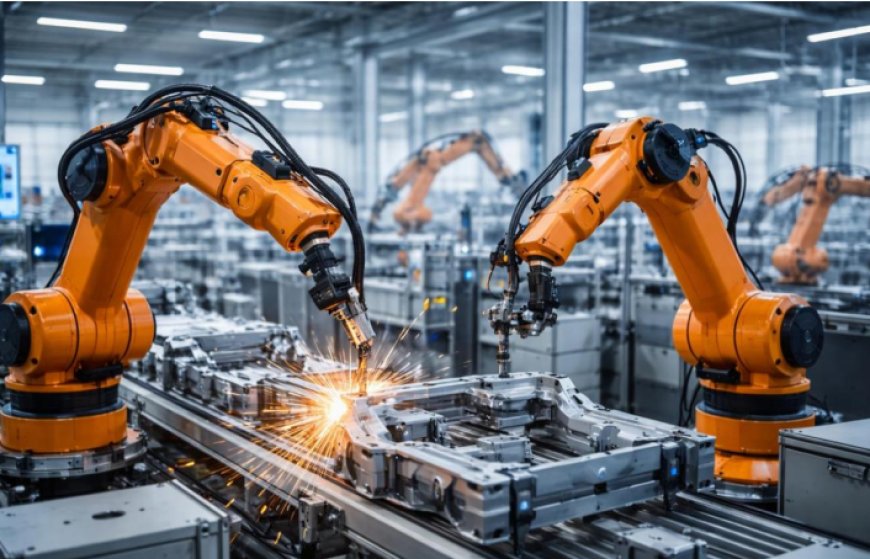
The global industrial landscape is undergoing a structural transformation as artificial intelligence and robotics converge to redefine manufacturing, logistics, and infrastructure systems. What was once a gradual automation trend has rapidly evolved into a full-scale industrial shift, driven by the dual forces of technological innovation and persistent labor shortages across advanced and emerging economies. Companies are no longer experimenting with robotics, they are deploying it at scale, embedding intelligence into physical systems to enhance productivity, efficiency, and resilience.
Recent data underscores the magnitude of this transition. The global market value of industrial robot installations has reached approximately $16.7 billion, reflecting record adoption levels across sectors such as automotive, electronics, and heavy manufacturing. At the same time, cumulative installed industrial robots are projected to exceed 5.5 million units globally by 2026, marking a significant milestone in automation penetration. These figures highlight a clear shift from selective automation to widespread industrial reliance on robotic systems.
This acceleration is not occurring in isolation. It is being reinforced by macroeconomic pressures, including rising labor costs, demographic shifts, and supply chain disruptions. As industries seek greater operational stability, robotics enhanced by AI capabilities has emerged as a critical solution. The result is a new industrial paradigm where machines are not just tools, but intelligent collaborators driving the next phase of economic growth.
AI Integration Reshaping Industrial Robotics
Artificial intelligence has fundamentally altered the capabilities of industrial robots, transforming them from rigid, pre-programmed machines into adaptive systems capable of learning and decision-making. Traditional robots operated within fixed parameters, executing repetitive tasks with precision but limited flexibility. Today, AI-enabled robots can analyze data, respond to environmental changes, and optimize their own performance in real time.
Industry collaborations are accelerating this evolution. For instance, recent partnerships between technology firms are focusing on integrating advanced simulation tools with AI models to train robots in virtual environments. This approach significantly reduces the time and cost required for real-world deployment while improving accuracy and safety. Such developments indicate a shift toward “intelligent automation,” where machines continuously improve through data-driven feedback loops.
Moreover, the emergence of “physical AI” is expanding robotics into previously inaccessible domains. According to industry research, nearly 79% of organizations are already engaging with physical AI technologies, with many actively deploying solutions across operations. This includes applications in hazardous environments, precision manufacturing, and logistics optimization—areas where human intervention is either risky or inefficient. The integration of AI is thus not incremental; it is redefining what robots can achieve.
Labor Shortages Driving Automation Demand
A critical driver behind the surge in robotics adoption is the growing shortage of skilled labor across key industries. Aging populations in developed economies, combined with declining interest in manual and repetitive work, have created structural gaps in the workforce. Companies are increasingly turning to automation not just for efficiency, but for operational continuity.
Evidence suggests that robotics is already reshaping workforce dynamics. In some regions, up to 11% of manufacturing workers now collaborate directly with AI-powered robotic systems, reflecting a hybrid work model where humans and machines operate side by side. At the same time, new job categories—such as robot operators and maintenance specialists—are emerging, indicating that automation is transforming rather than eliminating employment.
However, industry leaders warn that the impact of robotics will deepen over time. Emerging technologies are expected to automate a significant portion of tasks currently performed by skilled trades, particularly as AI capabilities improve. While this raises concerns about job displacement, it also highlights the urgency of reskilling and workforce adaptation. The long-term trajectory points toward a labor market increasingly shaped by human-machine collaboration.
Market Expansion and Investment Surge
The financial dimension of the robotics boom is equally significant, with global investments pouring into automation technologies at an unprecedented scale. The AI-powered industrial robotics market alone is projected to grow from approximately $17.9 billion in 2026 to over $33 billion by 2035, reflecting sustained demand and long-term industry confidence.
Broader estimates suggest that the overall robotics market could exceed $70–80 billion by 2026, driven largely by industrial applications. This growth is being fueled by both private sector investments and government initiatives aimed at strengthening domestic manufacturing capabilities. Nations are increasingly viewing robotics as a strategic asset, essential for economic competitiveness and supply chain resilience.
Corporate investment trends further reinforce this momentum. Companies are allocating significant capital toward research and development, particularly in AI-driven robotics systems that promise higher efficiency and scalability. This influx of funding is accelerating innovation cycles, enabling faster commercialization of advanced technologies. As a result, the robotics sector is evolving into one of the most dynamic and capital-intensive segments of the global economy.
Emerging Applications Across Industries
The scope of industrial robotics is expanding far beyond traditional manufacturing, encompassing a wide range of sectors including healthcare, logistics, energy, and agriculture. In logistics, autonomous robots are revolutionizing warehouse operations, enabling faster and more accurate order fulfillment. In healthcare, robotic systems are assisting in surgeries and diagnostics, improving precision and patient outcomes.
Industrial applications are also becoming more sophisticated. Advanced robotics systems are now capable of performing complex inspections, maintenance tasks, and quality control processes. In sectors such as oil and gas, robots are being deployed in hazardous environments, reducing risks to human workers while maintaining operational efficiency. These applications demonstrate the versatility and scalability of modern robotics technologies.
Additionally, the integration of robotics with data ecosystems is creating new opportunities for innovation. Companies are leveraging real-world data to train and refine robotic systems, enhancing their adaptability and performance. This data-driven approach is enabling robots to operate effectively in dynamic and unstructured environments, further expanding their potential use cases across industries.
Outlook
The rapid expansion of industrial robotics marks a pivotal moment in the evolution of global industry. What began as a tool for efficiency has evolved into a cornerstone of modern economic systems, driven by the convergence of artificial intelligence, labor dynamics, and strategic investment. The scale and speed of this transformation suggest that robotics will play an increasingly central role in shaping the future of work and production.
Looking ahead, the trajectory of the robotics industry points toward continued growth and innovation. Advances in AI, simulation technologies, and data integration are expected to further enhance the capabilities of robotic systems, enabling them to perform increasingly complex tasks. At the same time, challenges related to cost, reliability, and workforce adaptation will need to be addressed to ensure sustainable adoption.
Ultimately, the rise of industrial robotics reflects a broader shift toward intelligent automation, where machines and humans collaborate to drive productivity and innovation. As industries navigate this transition, the ability to harness the full potential of robotics will be a defining factor in determining economic competitiveness and resilience in the years to come.