































Sony AI Robot ‘Ace’ Defeats Elite Players, Marking Major Leap in Real-World Robotics
Sony’s AI robot Ace defeats elite table tennis players, showcasing a breakthrough in physical AI with real-world precision, speed, and adaptability.

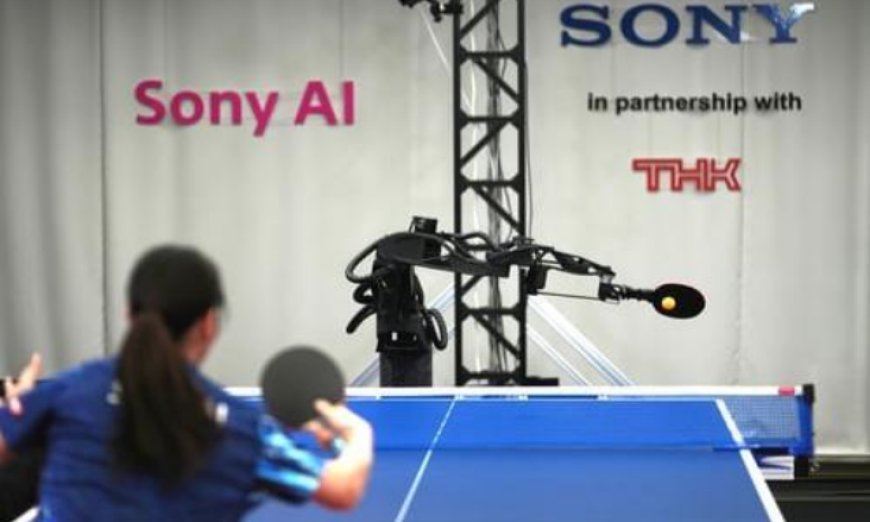
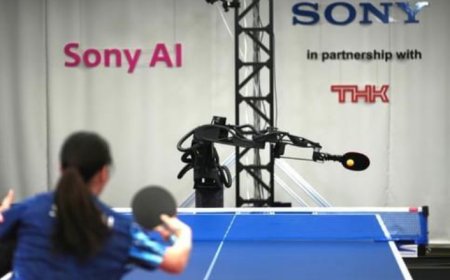
A landmark breakthrough in artificial intelligence and robotics has been achieved as Sony’s AI division unveiled its table tennis robot “Ace,” capable of competing with—and in some cases defeating—elite human players.
The development marks a major leap in what experts describe as “physical AI,” where machines are no longer confined to digital problem-solving but operate effectively in real-world, dynamic environments. The achievement has drawn global attention as a turning point in how artificial intelligence interacts with physical tasks requiring speed, precision, and adaptability.
Unlike traditional AI systems that excel in virtual environments such as chess or simulations, Ace operates in a fast-paced, unpredictable physical setting. Table tennis, widely regarded as one of the most demanding sports in terms of reaction time and coordination, presents a unique challenge for machines. The robot’s ability to perform at near-human levels and even outperform elite players in certain matches highlights the rapid progress of AI technologies moving beyond theoretical applications into practical, real-world scenarios.
The implications of this advancement extend far beyond sports. Researchers emphasize that the technologies powering Ace could transform industries ranging from manufacturing to healthcare, where precision, timing, and adaptability are critical. As physical AI continues to evolve, the success of Ace represents not just a technological milestone but a glimpse into a future where humans and intelligent machines increasingly share physical spaces and tasks.
Breakthrough in Physical AI Capabilities
The success of Ace lies in its ability to integrate perception, decision-making, and execution in real time. The robot is equipped with nine synchronized cameras and advanced vision systems capable of tracking the speed, trajectory, and spin of a table tennis ball with extraordinary accuracy. These systems process information at speeds that exceed human visual capabilities, enabling Ace to respond to shots that would appear as a blur to the human eye.
In addition to its visual system, Ace features a custom-built robotic arm with eight joints, allowing for highly precise control over racket movement. This configuration enables the robot to adjust position, angle, and force dynamically, replicating and in some cases surpassing the mechanics of human play. The combination of hardware and software allows Ace to execute complex shots, including spin variations and rapid counterattacks, with remarkable consistency.
What sets Ace apart is not just its mechanical precision but its ability to operate under competitive conditions. Matches were conducted under official rules governed by the International Table Tennis Federation, with licensed umpires overseeing gameplay. This ensured that the robot’s performance was evaluated in a realistic and standardized environment, reinforcing the credibility of the achievement.
Training, Learning, and Unique AI Approach
Ace’s capabilities are the result of an advanced training process rooted in reinforcement learning and simulation. Rather than learning by observing human players, the robot was trained through thousands of hours of simulated gameplay, allowing it to develop its own strategies and responses. This approach enabled Ace to explore a wide range of scenarios and optimize its performance through trial and error.
The training process involved over 3,000 hours of simulated matches, during which the AI system refined its decision-making and motor control. By operating in a virtual environment, the robot could experiment with different techniques and adapt to varying conditions without the limitations of physical testing. This method significantly accelerated its learning curve and contributed to its ability to handle complex, real-world gameplay.
Interestingly, Ace’s training approach has resulted in a playing style that differs from human strategies. Players who competed against the robot noted its unpredictability and lack of emotional cues, making it difficult to anticipate its moves. This highlights a key characteristic of AI systems—they are not bound by human habits or biases, allowing them to approach problems in novel ways.
Performance Against Human Players
Ace’s performance against human players has been one of the most compelling aspects of the project. In controlled matches, the robot achieved victories against elite players and demonstrated competitive performance against professional athletes. Reports indicate that Ace won multiple matches against top-level competitors, though it still faces challenges against the very highest tier of professional players.
Professional players who faced Ace described the experience as both challenging and unique. The robot’s ability to read spin and react instantly created situations that were difficult to counter. One player noted that Ace could return complex serves with equally intricate spin, while another highlighted its consistency and lack of fatigue as key advantages.
Despite its strengths, Ace is not without limitations. Experts point out that the robot can struggle with certain types of shots, particularly slower or less predictable ones. Human players, with their ability to adapt and exploit weaknesses, still maintain an edge in certain scenarios. However, the gap between human and machine performance is narrowing rapidly, suggesting that further advancements could soon close this gap entirely.
Industry Implications and Future Applications
The success of Ace has significant implications for industries beyond sports. The technologies developed for the robot—particularly its ability to perceive, plan, and act in real time—can be applied to a wide range of fields. In manufacturing, for example, robots equipped with similar capabilities could perform complex assembly tasks with greater efficiency and precision.
In healthcare, physical AI systems could assist in surgeries or rehabilitation, where accuracy and adaptability are crucial. The ability to respond to dynamic environments also opens possibilities in areas such as logistics, service robotics, and even disaster response. Experts suggest that the techniques demonstrated by Ace could serve as a foundation for the next generation of intelligent machines.
The development also highlights a broader trend in artificial intelligence—the convergence of digital and physical capabilities. As AI systems become more integrated with robotics, the distinction between virtual intelligence and real-world action is increasingly blurred. This convergence is expected to drive innovation across multiple sectors, reshaping how work is performed and how technology interacts with society.
Conclusion
The emergence of Sony AI’s Ace robot represents a pivotal moment in the evolution of artificial intelligence. By achieving expert-level performance in a physically demanding sport, the robot has demonstrated that AI is no longer limited to abstract problem-solving but can operate effectively in real-world environments. This milestone underscores the rapid pace of technological advancement and the expanding scope of AI applications.
Looking ahead, the development of physical AI is likely to accelerate, driven by ongoing research and investment. As systems become more sophisticated, their ability to perform complex tasks with human-like precision will continue to improve. This raises important questions about the future of work, human-machine collaboration, and the ethical implications of increasingly capable machines.
Ultimately, Ace’s success is not just about winning matches against human players—it is about redefining the boundaries of what machines can achieve. As the technology matures, it has the potential to transform industries, enhance productivity, and create new opportunities, marking the beginning of a new era in artificial intelligence.