
































Indiana Flooding: White River Shatters 113-Year Record as Death Toll Rises to Six
Indiana flooding has killed at least six people as the White River shattered a 113-year-old record, prompting a federal emergency declaration from Trump.

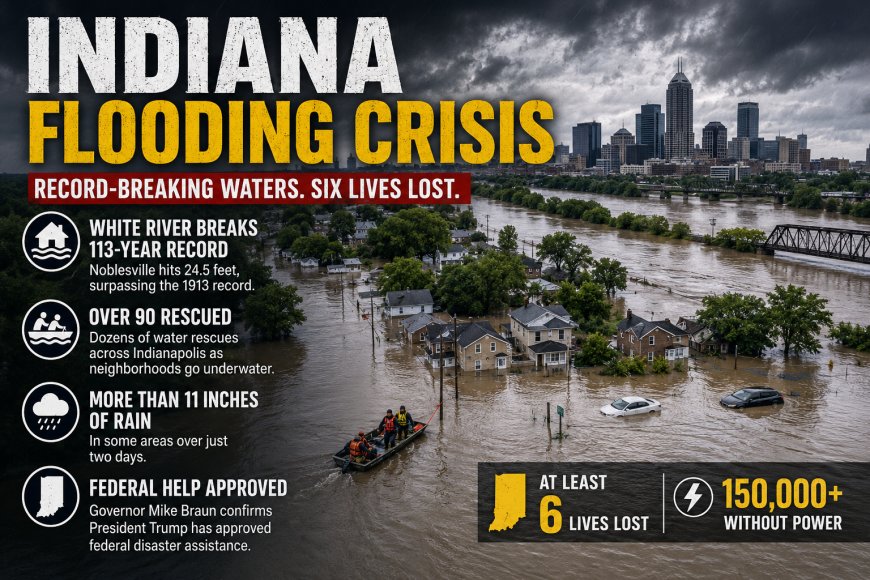
Indiana flooding has now claimed at least six lives after a week of relentless rainfall pushed the White River past a flood record that had stood for 113 years, submerging entire neighborhoods across central Indiana and prompting Governor Mike Braun to confirm that President Donald Trump has agreed to approve federal emergency assistance for the state.
A Record That Stood Since 1913 Is Broken
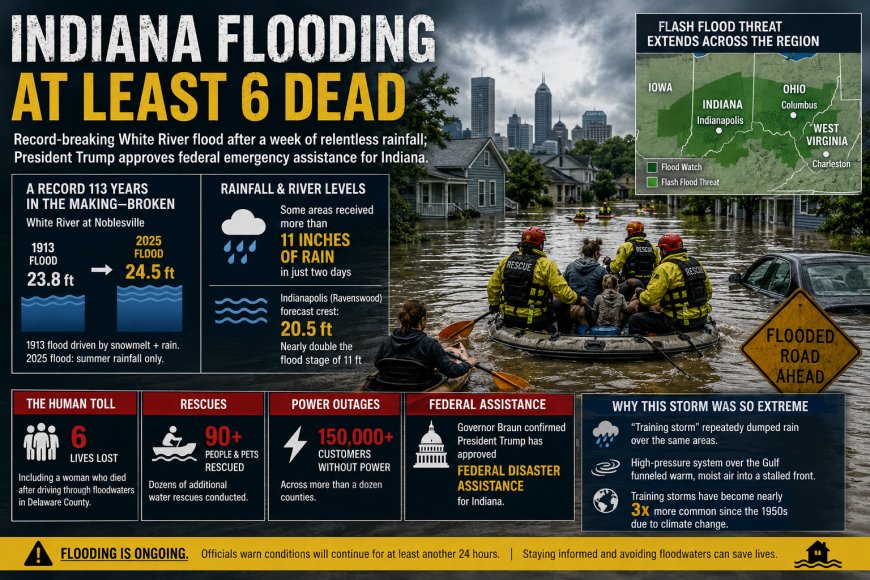
The scale of the Indiana flooding became starkly clear in Noblesville, roughly 15 miles upstream from Indianapolis, where the White River broke its own 1913 record of 23.8 feet before 2 a.m. Saturday, eventually reaching a forecast crest of 24.5 feet. What makes the achievement, if it can be called that, especially striking to meteorologists is that the 1913 flood was driven by spring snowmelt combined with heavy rain, while this year's Indiana flooding is a summer-only rainfall event — arriving without any of the snowmelt advantage that helped produce the earlier record. In Indianapolis itself, the river at Ravenswood near East 75th Street was forecast to crest around 20.5 feet Saturday afternoon, nearly double the river's established flood stage of 11 feet.
The National Weather Service reported that some areas of the state received more than 11 inches of rain over a two-day period, an extraordinary total that overwhelmed drainage systems and rivers already saturated from days of earlier storms. Jacob Spence, director of Marion County Emergency Management, described the Indiana flooding to the Associated Press as an unprecedented, once-in-a-lifetime type of event, adding that the region was setting new records it had never anticipated breaking.
Neighborhoods Underwater, Residents Rescued by Boat
Indianapolis Mayor Joe Hogsett did not mince words at a Saturday briefing, telling reporters that the city was experiencing its most severe flooding in more than 30 years, with conditions shifting rapidly by the hour. Drone footage captured by NBC News showed murky floodwaters swallowing streets in the Ravenwood neighborhood, submerging cars and rising to front doors, as residents navigated the inundated streets in kayaks and rowboats.
More than 90 people and their pets were rescued as floodwaters rose along the White River in Indianapolis, according to officials, with emergency crews conducting dozens of additional water rescues as the Indiana flooding continued to intensify through the weekend. Notably, Indianapolis itself did not receive the heaviest rainfall from the storm system; instead, Governor Braun explained, floodwaters moved downstream into the city from upstream areas that had recorded between 6 and nearly 12 inches of rain over the preceding days.
The Human Toll
The death toll from the Indiana flooding stood at six as of Saturday evening, according to state officials, with damage concentrated along the White River corridor stretching from Hamilton County into the northern suburbs of Indianapolis. Farther east, in Delaware County, sheriff's deputies recovered the body of a 58-year-old woman on Friday, believed to have died after attempting to drive through floodwaters — a tragically familiar pattern in flash flood disasters, where drivers consistently underestimate the danger of moving water until it is too late.
"My heart is with the families and loved ones of the five Hoosiers we have lost and every family whose life has been changed by these storms," Governor Braun said in a statement, with the toll subsequently updated to six as further confirmations came in.
More than a dozen counties across the state have declared local disasters as the scale of the Indiana flooding has become apparent, with more than 150,000 customers left without power as of Saturday's briefing, according to Indiana Department of Homeland Security Executive Director Jonathan Whitham.
Washington Responds
By Saturday afternoon, the crisis had reached the White House. Governor Braun confirmed he had spoken directly with President Trump about what he described as the severe storms and historic flooding impacting Indiana, and that the President had agreed to provide federal disaster assistance. Braun had formally requested a presidential emergency declaration on Friday, seeking to unlock additional federal resources for the state's response and eventual recovery effort.
Why This Storm Was So Extreme
Meteorologists point to a phenomenon known as a "training storm" as the underlying mechanism behind the extreme Indiana flooding — a weather pattern in which repeated bands of thunderstorms move over the same geographic area in succession, each one dumping additional rain onto ground that has no time to recover between downpours. A high-pressure system parked over the Gulf of Mexico acted as a conveyor belt, continuously funneling warm, moisture-laden air toward a stalled weather front over the region. Even minor disturbances in the jet stream, the kind that might ordinarily produce a passing afternoon thunderstorm, were enough to trigger fresh deluges over already-saturated terrain.
Climate scientists have documented this type of training-storm pattern becoming nearly three times more common since the 1950s, a shift they attribute in part to changes in jet stream behavior linked to a warming Arctic. The National Oceanic and Atmospheric Administration's Weather Prediction Center had placed parts of the Midwest under its highest-tier Moderate Risk designation for excessive rainfall in the days leading up to the disaster.
Not Over Yet
Officials have been clear that the Indiana flooding crisis is far from resolved. Whitham told reporters Saturday that flooding remained an ongoing issue expected to continue for at least another 24 hours before any recovery process could realistically begin. A flash flood threat extended across several states Saturday afternoon, stretching from eastern Iowa to West Virginia, with flood watches remaining active for cities including Indianapolis, Columbus, Ohio, and Charleston, West Virginia, as additional rounds of heavy rain and thunderstorms were forecast to move through the region over the following day.
With soil across the wider Midwest still saturated from the preceding week's storms, forecasters warned that any further rainfall carried the risk of triggering fresh rounds of significant flash flooding wherever the heaviest bands happened to develop — leaving emergency managers across multiple states on alert even as Indiana works to assess the full scope of damage from a flood that has already rewritten the record books.