































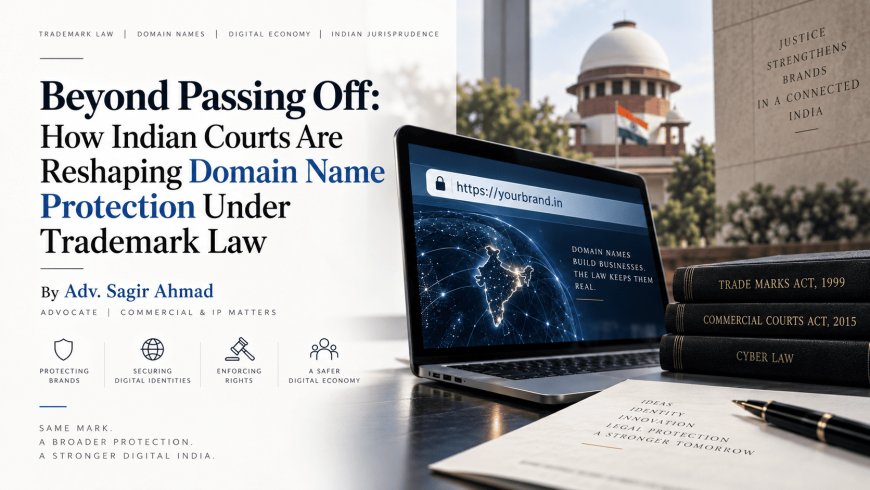
Beyond Passing Off: How Indian Courts Are Reshaping Domain Name Protection Under Trademark Law
Adv. Sagir Ahmad examines domain name protection under Indian trademark law, from passing off and Satyam Infoway to dynamic and dynamic+ injunctions.

A domain name today does more than point a browser to a server. It is often the first — and sometimes the only — commercial identity a business presents to the public. Indian courts recognised this reality more than two decades ago, but the last eighteen months have seen the law move well past the original passing-off framework into a far more muscular, technology-aware regime of enforcement. For anyone dealing with commercial disputes, that evolution is worth tracing carefully, because it says as much about the mechanics of interim relief in the digital economy as it does about trademark doctrine itself.
The Starting Point: Domain Names Have No Dedicated Statute
The Trade Marks Act, 1999 does not mention domain names. When the first disputes reached Indian courts in the late 1990s, this absence created a real doctrinal gap: was a domain name merely a technical address, like a postal code, or was it a source identifier deserving the same protection as a trademark?
The Delhi High Court answered this in Yahoo! Inc. v. Akash Arora, one of the earliest cybersquatting cases anywhere in the common law world. The defendant had registered "yahooindia.com" and was offering services nearly identical to the plaintiff's. The court held that the absence of a statutory registration for "Yahoo!" in India did not matter — the mark's global reputation and prior use were sufficient to found an action in passing off, and a domain name confusingly similar to a well-known mark could mislead consumers exactly as a counterfeit product would. This was the first judicial recognition in India that internet users treat domain names as guarantees of origin, not just addresses.
Five years later, the Supreme Court settled the question definitively in Satyam Infoway Ltd. v. Sifynet Solutions Pvt. Ltd. The respondent had registered "siffynet.com" and "siffynet.net," phonetically and visually close to the appellant's established "Sify" business. The Court held that a domain name has evolved from being a mere internet address into a business identifier, and that the principles of passing off under the Trade Marks Act apply with full force to domain name disputes. Importantly, the Court also flagged a structural difference between trademarks and domain names: a trademark can coexist across jurisdictions and classes of goods, but a domain name is globally unique — there can only ever be one registrant of a given string. This uniqueness, the Court observed, is precisely what makes domain name disputes more urgent and less tolerant of concurrent use than ordinary trademark conflicts.
Together, these two judgments built the foundation that every subsequent domain name case in India rests on: no separate law is needed, because passing off and infringement principles under the Trade Marks Act extend naturally to domain names once they are understood as source identifiers.
The Institutional Layer: INDRP and Its Limits
Parallel to this judicial development, an administrative mechanism was built for domain names ending in ".in" and ".bharat." The .IN Domain Name Dispute Resolution Policy, administered by the National Internet Exchange of India (NIXI), mirrors the international Uniform Domain Name Dispute Resolution Policy (UDRP) used for generic top-level domains such as ".com" through WIPO. A complainant must show that the disputed domain is identical or confusingly similar to a mark in which it holds rights, that the registrant has no legitimate interest in it, and that it was registered or used in bad faith.
INDRP proceedings are arbitral in character, binding under the Arbitration and Conciliation Act, 1996, and can only be challenged in the limited circumstances contemplated under Section 34 of that Act — not appealed on merits. This makes INDRP fast and inexpensive relative to civil litigation, but it also means the mechanism is poorly suited to complex, fast-moving fraud. It handles one domain at a time, requires a fresh complaint (and a fresh fee) for each variant a bad-faith registrant creates, and cannot bind unrelated registrars, banks, or telecom providers who may be inadvertently facilitating the fraud. That structural limitation is precisely what has pushed trademark owners back into civil court over the past two years.
The New Frontier: Dynamic and Dynamic+ Injunctions
The most significant recent development is not a new doctrine of liability but a new architecture of relief. Indian courts — the Delhi High Court in particular — have begun applying "dynamic" and "dynamic+" injunctions, tools first developed in copyright piracy litigation, to trademark and domain name fraud.
In L'Oréal India (through its authorised representative) v. Unknown Defendants, decided on 4 March 2025, the Delhi High Court granted a permanent injunction against a fraudulent website at "lorealglobal.in" that had copied the plaintiff's marks and site design to impersonate the company and mislead consumers, and directed NIXI not to permit any future registration incorporating the L'Oréal mark under the ".in" and ".co.in" extensions.
That approach was substantially expanded in a batch of commercial suits — involving marks including Dabur, Tata Sky, Bajaj Finance, Colgate, Meesho, Croma and ITC — decided together by Justice Prathiba M. Singh on 24 December 2025. The Court found that fraudulent registrants were routinely creating fresh infringing domains the moment an earlier one was blocked, often to run fake job or franchise schemes that had caused individual victims losses running into several crores of rupees. To address this, the Court granted "dynamic+" interim injunctions that automatically extend to future domain names incorporating the same mark — whether identical, prefixed, suffixed, or presented as alphanumeric variants — without requiring the plaintiff to return to court for each new domain. For well-known or highly distinctive marks, the injunction can cover all extensions and variants; for descriptive or generic marks, relief remains confined to the specific infringing domain unless extended through the Joint Registrar.
The judgment goes further than injunctive scope. It directs domain name registrars to discontinue offering WHOIS privacy protection as a default setting, mandates e-KYC verification of registrants, requires registrars to appoint grievance officers with published contact details, and — notably for a trademark judgment — directs banks to implement the RBI's "Beneficiary Bank Account Name Lookup" facility so that payers can verify a recipient's identity before transferring money. A registrar or platform that fails to comply with a dynamic+ order risks losing the safe-harbour protection ordinarily available to intermediaries under the Information Technology Act.
This is a meaningful doctrinal shift. Where Satyam Infoway established that a domain name is a source identifier deserving protection, the 2025 line of cases establishes that protecting it may require binding an entire ecosystem — registrars, registries, telecom providers and banks — because the infringing conduct migrates faster than a single-domain injunction can follow it.
Why This Matters for Commercial Court Practice
Trademark disputes fall squarely within the definition of "commercial dispute" under Section 2(1)(c)(vii) of the Commercial Courts Act, 2015, which brings domain name suits within the procedural regime of case management hearings, structured written submissions, and the summary judgment mechanism under Order XIIIA of the CPC. Two practical consequences follow.
First, interim relief in these matters is rarely a one-time event. A dynamic+ injunction anticipates that the registry will need to keep implementing court directions long after the original order — through Joint Registrar applications to extend relief to newly discovered domains, and through compliance monitoring against registrars and intermediaries. A researcher assisting on such a matter needs to track post-decree compliance, not just the judgment itself.
Second, the bad faith and legitimate interest inquiry — inherited from INDRP and UDRP jurisprudence and now imported into civil suits — remains fact-intensive. Courts continue to examine timing of registration relative to the plaintiff's reputation, the registrant's stated purpose, use of disclaimers, and the degree of visual and phonetic similarity, largely along the lines set out in Yahoo! v. Akash Arora and Satyam Infoway. What has changed is the remedy available once bad faith is shown, not the test for establishing it.
Conclusion
Two decades separate Yahoo! v. Akash Arora from the Delhi High Court's December 2025 order in the Dabur batch of suits, but the doctrinal thread connecting them is unbroken: a domain name is a business identifier, and passing off principles apply to protect it. What has evolved is the court's appreciation of scale — a single infringer can now generate dozens of infringing domains faster than traditional litigation can respond, and the remedy has had to evolve from a single injunction against a single domain to a standing, self-extending order backed by an entire compliance ecosystem. For commercial courts increasingly handling IP-driven fraud alongside conventional trademark disputes, this trajectory is likely to define how domain name jurisprudence develops over the next several years.
Adv. Sagir Ahmad is an advocate enrolled with the Bar Council of Delhi, with professional interests in commercial law, intellectual property, trademark law and emerging legal issues involving technology and digital commerce.
LinkedIn: https://www.linkedin.com/in/advsagir/
Email: advocatesagir1@gmail.com
legal@founderslegaldesk.com
Mobile No: +91 9711752388
Website: www.founderslegaldesk.com
Key Cases Referenced
- Yahoo! Inc. v. Akash Arora & Anr., 1999 IIAD (Delhi) 229
- Satyam Infoway Ltd. v. Sifynet Solutions Pvt. Ltd., (2004) 6 SCC 145
- L'Oréal India v. Unknown Defendants, Delhi High Court, order dated 4 March 2025
- Dabur India Limited v. Ashok Kumar & Ors. (and connected matters), Delhi High Court, order dated 24 December 2025