






























Inside the India-Germany Talent Corridor: How Accel Skill Is Rewiring Global Migration
Nearly 600,000 Indians moved to OECD nations in a year. See how Accel Skill Edutech is building a compliant pipeline into Germany's labour shortage.
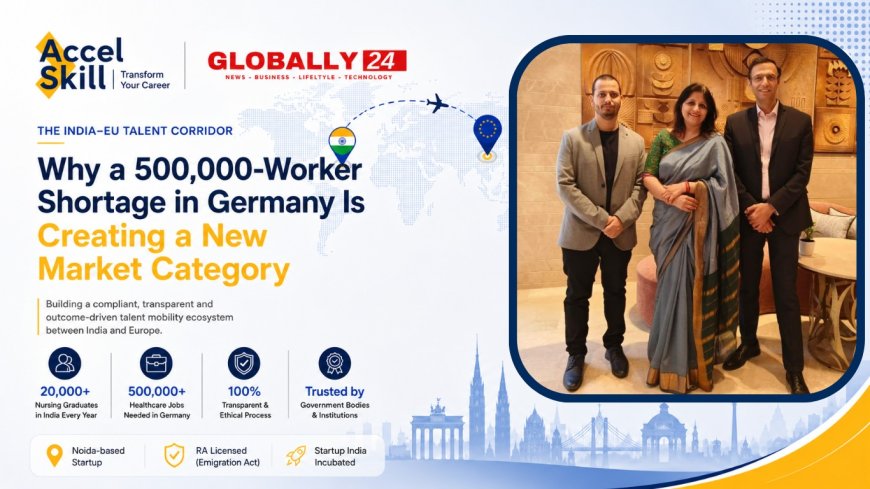
In 2023, nearly 600,000 Indians moved to OECD countries — an 8% jump year-on-year, and enough to make India the single largest source of migrants to the developed world, according to the OECD's International Migration Outlook 2025. Applications for the UK's Health and Care Worker visa from Indian nationals rose 75%. Germany rewrote its Skilled Immigration Act (Fachkräfteeinwanderungsgesetz) specifically to open new legal pathways for non-EU workers, with Indian nationals identified as among its primary intended beneficiaries.
The macro picture is unambiguous: the developed world needs workers, and India has them. What has been missing is trustworthy infrastructure connecting the two — and that is the gap Accel Skill Edutech Pvt. Ltd., a Noida-based startup founded in February 2024, is built to close.
A Migration Story Before It Was a Business
There is a woman in Kanpur named Akshara who completed her BSc Nursing in 2023 with distinction. She wanted a nursing career in Germany, a country that, by its own government's admission, needs half a million healthcare workers with urgency. Between Akshara and a job in Frankfurt lay a maze of language certificates, credential recognition, visa categories, immigration regulations and fraudulent placement agents. She is one of roughly 200,000 nursing graduates India produces every year — a supply that, on paper, should flow cleanly into Germany's shortfall. It doesn't, because the intermediary layer connecting the two sides of this ledger is largely unregulated and, in a meaningful share of cases, actively exploitative. Hundreds of thousands of workers are defrauded annually by placement agents, losing savings and career prospects in the process.
Two Founders, Two Sides of the Corridor
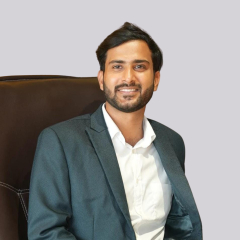
Co-founders Yashwinder Paal Siingh and Archana Thakran each anchor one end of the mobility pipeline. Yashwinder was born into a defence family and grew up without a permanent address, moving across cantonment towns from north to south India before travelling extensively through developed economies — an upbringing that gave him a first-hand, comparative view of how structured, transparent labour markets operate elsewhere in the world. His founding thesis: the sector is broken not by weak demand or supply but by a trust deficit — candidates can't verify who to trust, employers can't verify which Indian partners are legitimate, and regulators are stretched thin across an informal, fragmented industry.
Archana's background spans India's higher-education and skilling ecosystem, giving Accel Skill genuine institutional credibility with colleges and universities across healthcare, hotel management, engineering and vocational education — the company's candidate supply pipeline. She also brings a personal data point that market research cannot replicate: close relatives who completed Germany's Ausbildung, the three-year dual vocational training programme, and are now established in European careers. Together, the two founders cover both ends of the corridor — Yashwinder the global mobility and regulatory-compliance side, Archana the domestic institutional and higher-education side.
Two Founders, One Corridor: The Full Picture
Every migration-facing company built for genuine social impact tends to need two things at its founding core: someone who sees the system clearly enough to want to rebuild it, and someone who has lived close enough to the change to know what it actually requires operationally. In Accel Skill, that duality plays out across its two co-founders in a way that maps cleanly onto the two sides of the corridor itself.
Archana Thakran, Co-Founder and CEO, brings something no market research exercise can replicate: personal, lived proximity to the very transformation the company is building at scale. Her close relatives completed Germany's Ausbildung — the three-year dual vocational education and training programme — and are today successfully progressing in their European careers. She has watched, at first hand, how a structured, transparent, internationally recognised pathway can alter a family's trajectory entirely. Professionally, her background across India's higher education and skilling ecosystem gives Accel Skill genuine credibility with the academic and university establishment, and she has cultivated a wide network of institutions spanning healthcare, hotel management, engineering and vocational education that today forms Accel Skill's candidate supply pipeline.
Yashwinder Paal Siingh's founding impulse came from years of observation rather than personal pain — watching a system fail people who deserved better, and concluding the failure was not inevitable. Born into a defence family, he grew up without a permanent address, moving across the length and breadth of India, from cantonment towns in the north to postings in the south, absorbing the country's extraordinary diversity in a way few professionals ever do. His extensive travel through developed countries gave him a first-hand, comparative view of how structured, transparent, outcome-oriented labour markets function elsewhere — knowledge that translates directly into how Accel Skill has built its employer-facing operations in Germany and Austria.
Why the Demand Side Is So Large
Two-thirds of European companies report structural — not cyclical — skill shortages. The EU's Digital Decade 2030 target alone requires 20 million additional ICT specialists. Germany's healthcare system needs 500,000 additional workers. The Gulf Cooperation Council faces comparable gaps in hospitality, construction and facility management. These are not seasonal fluctuations; they are demographic curves that will not correct themselves without deliberate, structured migration pathways.
Building the Missing Infrastructure
Accel Skill's answer is an end-to-end, zero placement-fee pathway operating under a Registered Recruiting Agent (RA) licence issued under India's Emigration Act — a compliance status most operators in this market don't hold, and one that legally bars the company from charging candidates placement fees. The model treats a candidate's success as the only real product: value is delivered only once someone is verifiably employed, performing, and financially stable abroad — not at enrolment, not at certificate issuance.
Candidates begin with a proprietary Language Learnability Assessment, a psychometric tool mapping cognitive learning profile and predicted acquisition trajectory into a personalised roadmap. From there, AI-adaptive modules combine with live-trainer classrooms to move candidates from German A1 through B2. The operational stack continues through credential verification, employer matching with a vetted network of German and Austrian companies, visa documentation support, pre-departure cultural orientation, and post-placement monitoring for three to six months after arrival — the stage where most competing agencies stop.
The company has already formalised government-facing partnerships, including MoUs with the Meghalaya State Skill Development Society and Medhavi Skills University, Sikkim — part of India's Ministry of External Affairs push, alongside engagement with Assam and other Northeast states, to build formal emigration pipelines into Europe.
The Policy Tailwind
This isn't happening in a vacuum. Germany's amended Skilled Immigration Act, the India-Germany Migration and Mobility Partnership Agreement, and an active India-Austria bilateral framework are converging with India's own strengthened enforcement of Emigration Act compliance. For a company that built RA licensing into its foundation rather than bolting it on later, that convergence is a structural advantage, not a regulatory hurdle. Where informal operators face rising exposure, Accel Skill's compliance-first posture becomes a genuine moat — one reinforced by institutional trust (each government MoU making the next partnership easier to close) and by the operational depth of a multi-year employer network and language-training build that a new entrant cannot replicate quickly.
A Corridor Measured in Development Goals, Not Just Placements
Development finance institutions increasingly evaluate migration-linked business models against the Sustainable Development Goals they structurally advance. Accel Skill's model maps onto SDG 4 (Quality Education) through its personalised, AI-driven learning platform; SDG 8 (Decent Work and Economic Growth) through fee-free, verified placement in above-market international roles; SDG 10 (Reduced Inequalities) through its tier-2/tier-3 and Northeast India focus; and SDG 5 (Gender Equality), given the high proportion of women — particularly in nursing — moving through its pipeline. Each successful placement generates remittances that support a family and fund a sibling's education, compounding the corridor's development impact with every additional worker who moves through it safely.
Why This Model Is Hard to Replicate
The EdTech and overseas placement sectors in India are both crowded, but genuine defensibility in this specific corridor rests on three layers that take years to build and cannot be assembled quickly. Regulatory compliance is the first: the RA licence excludes the majority of placement operators who function informally, and it signals to international employers that Accel Skill operates inside a legal framework they can safely partner with. Institutional trust is the second, and it compounds — a government MoU functions as an endorsement of the company as a trustworthy actor for a state's most vulnerable youth, and each additional partnership makes the next one easier to close. Operational depth is the third, and arguably the hardest to copy: building a functioning pipeline of verified European employers requires years of relationship capital, and building the language-training infrastructure to take a candidate from zero German to B2 requires sustained curriculum investment that a new entrant cannot shortcut.
For a global migration analyst, this three-layer moat is also a useful proxy for how the broader India-EU corridor is likely to consolidate: as regulatory scrutiny increases on both sending and receiving ends, informal intermediaries will find it progressively harder to operate, and the compliant operators who built early will hold a widening structural advantage.
A Corridor Built Around People
The data is abstract until you meet the candidates moving through it. Devyani from Churu, Rajasthan, had never spoken to a European employer and had no German language before enrolling; she is now working through German A2 with her credential verification in process. Mukul from Delhi is navigating the Ausbildung route, describing Accel Skill as the first organisation to give him an honest, step-by-step roadmap rather than a sales pitch. Akshara from Kanpur is now in an advanced stage of her Germany nursing application, her German B1 certificate complete.
Co-founder Yashwinder frames the company's purpose around a single recurring moment rather than a metric: the phone call a candidate makes home the day they land in Germany. "That call — the sound of it — is why we do this," he says. "Not the placement rate. Not the revenue multiple."
These candidates are representative of a broader pipeline moving through the corridor today — primarily from tier-2 and tier-3 cities, primarily women, disproportionately from states with historically limited access to international career infrastructure. For a migration researcher, that demographic composition is itself significant: it suggests a compliant, well-built pipeline can widen who actually benefits from a corridor like this, rather than simply serving the urban, already-connected candidates who tend to access global opportunity fastest under informal systems.
Sequencing the Corridor's Growth
Accel Skill's current focus is deliberately narrow — Germany and Austria, across nursing, hospitality and the Ausbildung vocational pathway — a sequencing choice the founders describe as depth before breadth, credibility before scale, and outcome track records before geographic expansion. That discipline matters in a migration context: corridors that scale too quickly, before verification infrastructure and employer trust are established, tend to be exactly where fraud and exploitation re-enter the system. By holding geographic expansion until each phase has demonstrated real placement outcomes, the company is betting that a slower, verifiable growth curve compounds into a larger and more durable corridor over time.
The Road Ahead
Accel Skill's five-year plan extends the model to 15 Indian states by 2028, concentrated in Northeast India, Bihar, Rajasthan and Madhya Pradesh, before a second phase carries it to the UK, Japan, Canada and the Gulf. The company describes its compliance-first architecture as deliberately portable across destination-country regulatory environments — a design choice that matters as much for a future Gulf expansion as it has for its current Germany and Austria corridor.
With Germany's Skilled Immigration Act amendments, the India-Germany Migration and Mobility Partnership, active frameworks with Austria and the Gulf, and India's tightening Emigration Act enforcement converging at once, migration analysts are watching this window closely. Platforms that establish trusted pipelines and institutional relationships now stand to hold a compounding advantage as the India-EU talent corridor — arguably one of the most consequential labour migration relationships of the next decade — continues to mature. Accel Skill's bet is that the operators who build it the accountable way, reaching the nursing graduate in Kanpur and the hospitality aspirant in Meghalaya rather than only the well-connected and urban, will be the ones still shaping the corridor when it does.
The Stakes for Global Migration Policy
What happens in this specific corridor over the next several years is likely to inform how policymakers on both sides think about structured labour migration more broadly. Governments negotiating bilateral mobility agreements need evidence that formal, government-backed pathways can actually outcompete informal and fraudulent channels at scale — not just in pilot numbers, but across tens of thousands of candidates over multiple years. Accel Skill's stated target of reaching candidates across 15 Indian states and multiple destination countries within five years is, in that sense, as much a policy experiment as it is a business plan: a test of whether a compliance-first, outcome-accountable model can absorb a meaningful share of the demand that currently flows, by default, through unregulated intermediaries.
If it succeeds at the scale the founders describe, the template — RA licensing, state government MoUs, portable compliance architecture, and multi-month post-placement support — offers a replicable blueprint not just for other Indian operators, but potentially for talent-sending countries facing similar trust deficits in their own migration corridors to Europe, the Gulf and beyond.
|
About Accel Skill Edutech Pvt. Ltd. Accel Skill Edutech Pvt. Ltd. is a pre-seed international talent mobility platform founded in February 2024 and headquartered in Noida, Uttar Pradesh. The company operates an end-to-end international career pathway platform across three verticals — Nursing & Allied Health (Germany), Hospitality (Europe & Gulf), and Ausbildung (Germany) — covering AI-powered language training, employer matching, visa guidance, and post-placement support. The company holds a Registered Recruiting Agent licence under India’s Emigration Act, is incubated at Amity Technology Incubator (Startup India recognised), holds MoUs with the Meghalaya State Skill Development Society and Medhavi Skills University (Sikkim), and is a member of the Indo-German Chamber of Commerce. Zero placement fees — always. Founders: Yashwinder Paal Siingh , Co-Founder & Director · Archana Thakran, Co-Founder & CEO www.accelskill.com · RA Licence No. B-3416/UP/COM/100/5/11376/2026 · Noida, India |