






























Global Markets Slide as Energy Price Shock Triggers G7 Emergency Talks
Global markets decline as oil prices surge, triggering G7 emergency talks and raising concerns over inflation, energy supply disruptions, and economic stability.


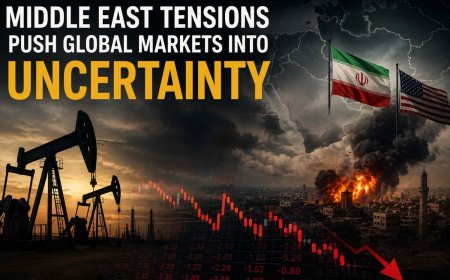
Global financial markets faced renewed volatility as surging energy prices and geopolitical tensions unsettled investors across the United States, Europe and Asia. Major equity indices including Wall Street benchmarks and Britain’s FTSE 100 declined as governments and financial institutions began emergency discussions on stabilising global energy markets amid supply disruptions.
The turmoil followed a sharp surge in crude oil prices triggered by concerns over supply disruptions and instability in key oil-producing regions. At one stage during recent trading sessions, Brent crude oil prices surged toward $120 per barrel, the highest levels seen since 2022, before easing amid reports that governments were considering releasing emergency oil reserves.
In response to the growing crisis, finance ministers from the Group of Seven (G7) nations, the United States, Canada, Britain, France, Germany, Italy and Japan held emergency consultations alongside leaders of major international institutions including the International Monetary Fund (IMF), World Bank, Organisation for Economic Co-operation and Development (OECD), and the International Energy Agency (IEA).
The discussions centred on the risks posed by rising energy prices to global economic stability and the potential use of strategic oil reserves to stabilise markets if supply disruptions intensify.
Energy Price Shock Rattles Global Financial Markets
The sudden spike in oil prices triggered a wave of selling across global stock markets as investors reassessed inflation risks and economic growth prospects. Energy price shocks are widely considered one of the most immediate threats to global economic stability because they affect production costs, transportation expenses and household energy bills simultaneously.
European markets were particularly affected during the initial market reaction. Britain’s FTSE 100 index declined by around 0.34 percent, while Germany’s DAX index dropped approximately 0.77 percent and France’s CAC 40 fell close to 1 percent amid the heightened uncertainty surrounding energy supply.
In the United States, major equity benchmarks also experienced declines as investors responded to rising fuel prices and the risk that prolonged energy shocks could accelerate inflation. Analysts noted that higher energy costs often trigger broad market sell-offs because they raise operating costs for industries ranging from manufacturing and aviation to logistics and agriculture.
Market strategists warned that energy-driven volatility could continue if geopolitical tensions persist. Financial institutions and investors are closely monitoring oil markets because even moderate disruptions to supply can rapidly translate into inflationary pressure and slower economic growth across developed and emerging economies.
G7 Governments Weigh Emergency Energy Measures
Amid mounting economic pressure, G7 finance ministers convened a virtual meeting to discuss coordinated policy responses to stabilise energy markets. The emergency consultation brought together government officials and leaders from international financial institutions to assess the potential economic fallout from the energy price surge.
During the meeting, officials discussed the possibility of releasing oil from strategic petroleum reserves through a coordinated mechanism overseen by the International Energy Agency (IEA). Such releases are designed to temporarily increase supply in global markets during periods of severe disruption.
According to IEA data, member countries collectively maintain over 1.2 billion barrels of public emergency oil reserves, in addition to roughly 600 million barrels of industry stocks held under government obligations. These reserves are intended to provide short-term relief during supply shocks, helping stabilise prices and maintain market confidence.
French economy minister Roland Lescure, who chaired the G7 meeting, stated that governments stand ready to take necessary measures to stabilise markets if conditions worsen. However, officials indicated that no immediate decision had been taken to release reserves, emphasising that the situation is still being closely monitored.
Oil Market Volatility Intensifies Economic Uncertainty
Energy markets have experienced extreme volatility as traders respond to shifting geopolitical developments and policy signals from governments. Oil prices initially surged amid fears of supply disruptions but later fell sharply after reports that global leaders were considering releasing strategic reserves.
At one point during recent trading, West Texas Intermediate (WTI) crude dropped nearly 12 percent to about $83 per barrel, while Brent crude fell more than 11 percent to around $87 per barrel following news of potential emergency stock releases.
Despite the temporary decline, analysts warn that the energy market remains highly sensitive to geopolitical developments. Even minor changes in supply expectations can trigger dramatic price swings because global demand for oil remains extremely high.
Energy economists note that the Strait of Hormuz, through which roughly 20 percent of global oil supply flows, remains a critical chokepoint for energy shipments. Any disruption to this shipping route could dramatically affect global supply chains and further intensify price volatility.
Inflation and Economic Growth Risks
Rising energy prices pose a serious challenge for policymakers because they can simultaneously increase inflation and slow economic growth. Higher fuel prices raise transportation and manufacturing costs, which are often passed on to consumers in the form of higher prices for goods and services.
European economists warn that sustained oil prices above $100 per barrel could significantly affect economic performance across the eurozone. Studies cited by economic institutes suggest that such price levels could reduce economic growth and increase inflation across several major economies.
For example, analysts estimate that sustained high oil prices could reduce Germany’s economic output and lead to tens of billions of euros in economic losses over the next two years if energy prices remain elevated.
Central banks are also closely monitoring the situation, as higher energy prices complicate efforts to control inflation. Monetary policymakers must balance the need to contain price increases while avoiding aggressive interest rate policies that could weaken economic growth.
Outlook
The volatility in global markets highlights the deep interconnection between energy supply and financial stability. As governments, central banks and international institutions monitor developments, the trajectory of oil prices will remain a critical factor influencing investor sentiment and economic forecasts.
While the potential release of strategic reserves could temporarily stabilise markets, analysts warn that such measures provide only short-term relief if geopolitical tensions persist. Structural energy supply disruptions or prolonged instability in key production regions could sustain elevated price levels.
For financial markets, the coming weeks will likely remain sensitive to developments in both energy markets and diplomatic negotiations aimed at easing tensions. Investors, policymakers and industry leaders are closely watching oil supply conditions and government policy responses.
Ultimately, the crisis underscores how quickly energy shocks can ripple through the global economy, influencing inflation, market stability and economic growth across the world’s largest economies.