


























Paris Fashion Week Men’s January 2026: What the Provisional Schedule Reveals
The provisional January 2026 menswear calendar signals Paris Fashion Week’s shift toward restraint, clarity and craft-led storytelling over spectacle

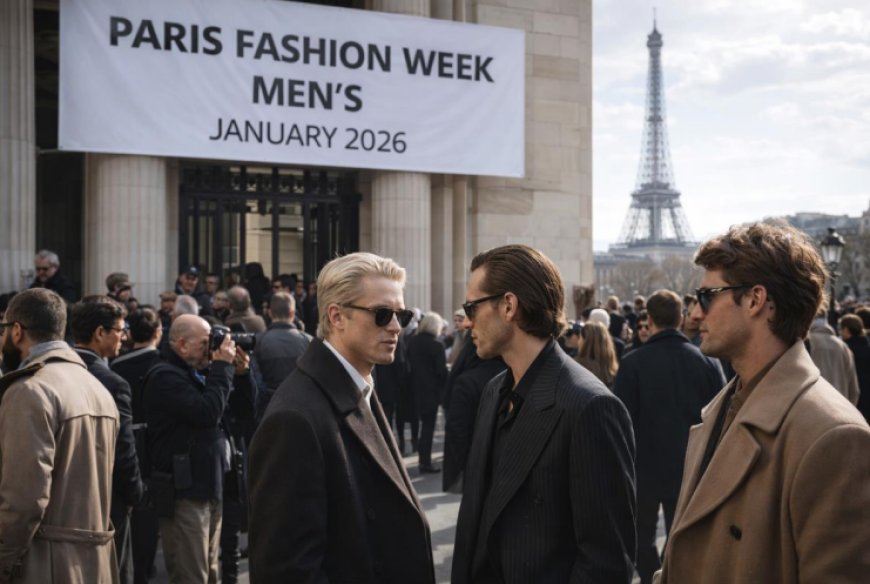
Paris Fashion Week Men’s January 2026 may still be weeks away, but the release of its provisional schedule has already begun to shape the season’s narrative. More than a logistical outline, the calendar offers an early insight into how the global menswear industry is recalibrating itself — creatively, commercially and culturally. In a moment marked by economic caution, creative introspection and shifting consumer expectations, the schedule reads less like a promise of spectacle and more like a statement of intent.
At first glance, the lineup feels reassuringly familiar. Established maisons occupy prominent positions, reinforcing Paris’s status as the industry’s most authoritative menswear platform. Yet beneath this sense of continuity lies a quieter evolution. The January 2026 calendar suggests a deliberate move away from excess — fewer overtly theatrical gestures, fewer attempts to dominate the conversation, and a renewed emphasis on clarity of identity. It is a season that appears shaped by restraint rather than urgency.
The pacing of the schedule itself is telling. Major houses are spaced carefully across prime slots, avoiding the overcrowding that has characterised past fashion weeks. This measured structure reflects a growing awareness of audience fatigue, both on the ground and online. After years of compressed calendars and relentless content cycles, the industry appears to be reclaiming time — allowing collections to breathe, be absorbed and understood on their own terms.
There is also a noticeable return to physical runway shows after recent seasons marked by films, presentations and off-calendar formats. While experimentation has not disappeared, the renewed focus on live shows signals a desire to reconnect with the tactile essence of menswear. Fabric movement, tailoring precision and proportion — elements central to men’s fashion — gain meaning through physical presence. Paris, it seems, is reaffirming the runway as a space for craft-led storytelling rather than digital abstraction.
Creatively, the schedule hints at a season defined by refinement rather than disruption. Houses known for traditional tailoring sit comfortably alongside designers exploring fluid silhouettes, softened masculinity and conceptual narratives. Rather than competing, these approaches coexist, reflecting the pluralism that now defines modern menswear. The absence of aggressive trend signalling suggests that many designers are choosing evolution over reinvention, deepening existing codes instead of chasing novelty.
This emphasis on continuity is not a sign of stagnation, but of confidence. In an uncertain global climate, designers appear increasingly focused on building enduring identities. Archival references, subtle shifts in proportion, and elevated craftsmanship are expected to take precedence over overt provocation. The schedule points to a season where menswear speaks through nuance — through texture, silhouette and intention — rather than spectacle.
Emerging designers remain an essential part of the Paris ecosystem, even as their presence feels more measured. Their placement within the calendar reflects both opportunity and realism. Paris continues to function as a proving ground, offering visibility while demanding coherence and clarity. For these labels, January menswear is less about shock value and more about articulation — of values, culture and perspective — in a market that increasingly rewards authenticity.
Beyond creative considerations, the provisional schedule also mirrors broader industry realities. Rising production costs, geopolitical uncertainty and evolving retail strategies have prompted brands to become more selective in how they present. The scale of the season, while still substantial, feels more intentional than expansive. This is fashion week as strategy rather than excess.
The choice of venues further reinforces this mood. Many shows are expected to take place in understated, architectural settings — historic buildings, intimate courtyards and industrial spaces — allowing the collections themselves to command attention. The city becomes a backdrop rather than a stage, aligning with menswear’s current gravitation toward grounded elegance.
Ultimately, what the January 2026 schedule reveals is not a single defining trend, but a collective mindset. Paris Fashion Week Men appears to be entering a phase of quiet assurance — one where strength lies in clarity, restraint and thoughtful progression. In an industry often driven by acceleration, this season signals a willingness to pause, refine and move forward with purpose.
As final confirmations roll in and collections take shape, Paris is poised to deliver a menswear season that values substance over noise. If the provisional schedule is any indication, January 2026 may be remembered not for spectacle, but for marking a more confident, considered era in contemporary menswear — one where evolution, rather than excess, defines the future.